

 History
African Muslims and the written record of early America
The West African lives and American experiences behind surviving manuscripts and family memories.
How changes in leadership, institutions, and local congregations reshaped a major African American Muslim community.
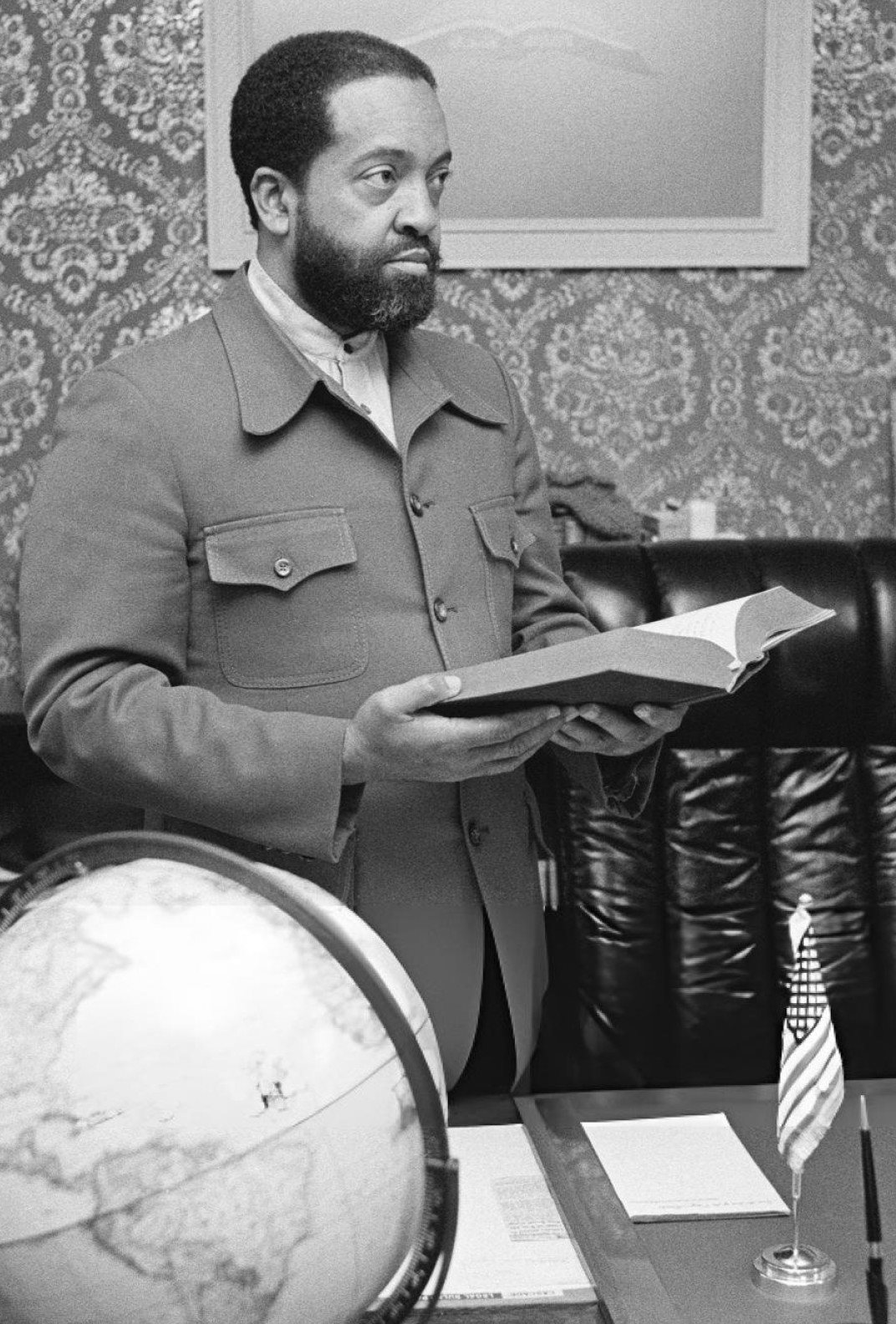
When Elijah Muhammad died in 1975, leadership of the Nation of Islam passed to his son, the man who became widely known as Imam Warith Deen Mohammed. What followed changed the names, practices, institutions, and public relationships of a major African American religious community. Many members later described these years simply as the transition.
The transformation reached far beyond a change at the top. Local congregations revised how they organized worship, understood racial identity, taught children, and related to the wider Muslim world. Families who had built institutions under the older movement had to work through those changes in their own neighborhoods.
Born in 1933, Mohammed grew up within the Nation of Islam’s leadership family. His relationship with his father’s teachings was complicated. PBS describes periods of exclusion from the movement and ordinary wage work before his reinstatement in 1974. His later reforms therefore grew from an intellectual and personal history that preceded his succession.
After assuming leadership in 1975, he began moving the organization toward Sunni Muslim belief and practice. PBS documents changes in terminology, leadership roles, dress expectations, and institutional structure. Temples became mosques, and ministers were called imams. The organization adopted the name World Community of al-Islam in the West. PBS biography
The changes also challenged racial separatism. Mohammed emphasized a wider Muslim community that crossed racial boundaries and encouraged participation in American civic life. His reform program involved theology, but its effects were visible in schools, congregational relationships, and public activity.
Harvard’s Pluralism Project describes the transition through the experiences of communities formerly affiliated with the Nation of Islam. Members learned new forms of worship and developed relationships with Muslims whose backgrounds differed from their own. Those changes required teaching, conversation, and practical adjustment within congregations. Harvard account
The process did not erase earlier commitments to education, self-reliance, or community organization. It redirected institutions that already had members, buildings, leadership networks, and years of collective work. This continuity is important when following a congregation through successive names.
Scholarly accounts describe substantial institutional and political changes through the late 1970s and 1980s. A national chronology is useful, but individual mosques followed their own local schedules of relocation, renaming, and reorganization. Oxford historical overview
Louis Farrakhan later re-established the Nation of Islam, continuing a different organizational path. Accounts of the period should identify the relevant institution and date rather than treating every African American Muslim congregation as part of one unchanged organization. The communities’ own names and records make those distinctions possible.
The Smithsonian holds a copy of The Teachings of W.D. Muhammad Book I. A teaching book is a particularly useful object for this history because a community-wide transformation depended on communication. Lectures and speeches had to become material that people could study, discuss, and use in local educational settings. Smithsonian collection record
Printed material also preserves the vocabulary of a particular stage in the transition. Titles, publication dates, and spellings can help establish where an item belongs in the chronology. A book’s existence should not be confused with evidence that every congregation used it in precisely the same way.
America’s Islamic Heritage Museum presents Mohammed within a broader history of American Muslim institutions. Its resources can be read alongside university scholarship and local archives, bringing national leadership into conversation with the people who carried institutional change into daily life. Museum profile
For readers visiting historically African American mosques, the transition often explains why a building, community, or school has several names in older records. A former temple may now be a Sunni mosque, and a congregation’s archives may preserve photographs and publications from both periods.
The most informative questions concern local experience. Who taught during the transition? Which schools continued? How did women, younger members, and longtime organizers describe the changes? Those answers give the history a scale that a leadership biography alone cannot supply.
Mohammed died in 2008, but congregations associated with his leadership remain part of American Muslim life. Their histories preserve both the transformation after 1975 and the earlier work that made those institutions possible.
The practical contribution is visible in institutions, not only a change of vocabulary. A congregation has teachers, trustees, property, pupils, and families who make decisions together. Changes in leadership and public outlook affect all of those relationships. To understand this period locally, compare a school's records with a mosque's anniversary history and oral testimony from members. A national biography cannot establish exactly when each community changed its name or practices.
This also makes room for people who rarely appear in accounts centered on prominent leaders. Maintaining a classroom or documenting a building's history is part of institutional continuity, even when a published source does not name the individual responsible. That is a research question, not an invitation to invent a representative volunteer. The sources here establish a major transformation and its leader; local archives can reveal how it was lived. Continue with preserving Muslim American history or return to Muslim roots in American history.
HistoryThe West African lives and American experiences behind surviving manuscripts and family memories.
 History
Explore the Cedar Rapids building, its restoration, and the community history behind a national landmark.
 History
Family reunification, professional migration, and institutions that grew across generations.