 Shop
How to Commission Arabic Calligraphy for Your Home
Prepare a clear brief for a calligrapher, from verified wording and script preferences to framing and delivery.
Questions about process, purpose, makers, and presentation to ask when buying ceramic art at a market or online.
A wall tile needs a way to hang; a ceramic sculpture needs a stable place to stand. Decide how you will display a piece before comparing makers. Its weight, depth and mounting requirements matter as much as the pattern you first notice.
Historical museum collections offer a vocabulary for looking, while contemporary markets provide opportunities to ask makers about their own work. Keep those two kinds of information connected without assuming that a present-day piece reproduces an older technique exactly.
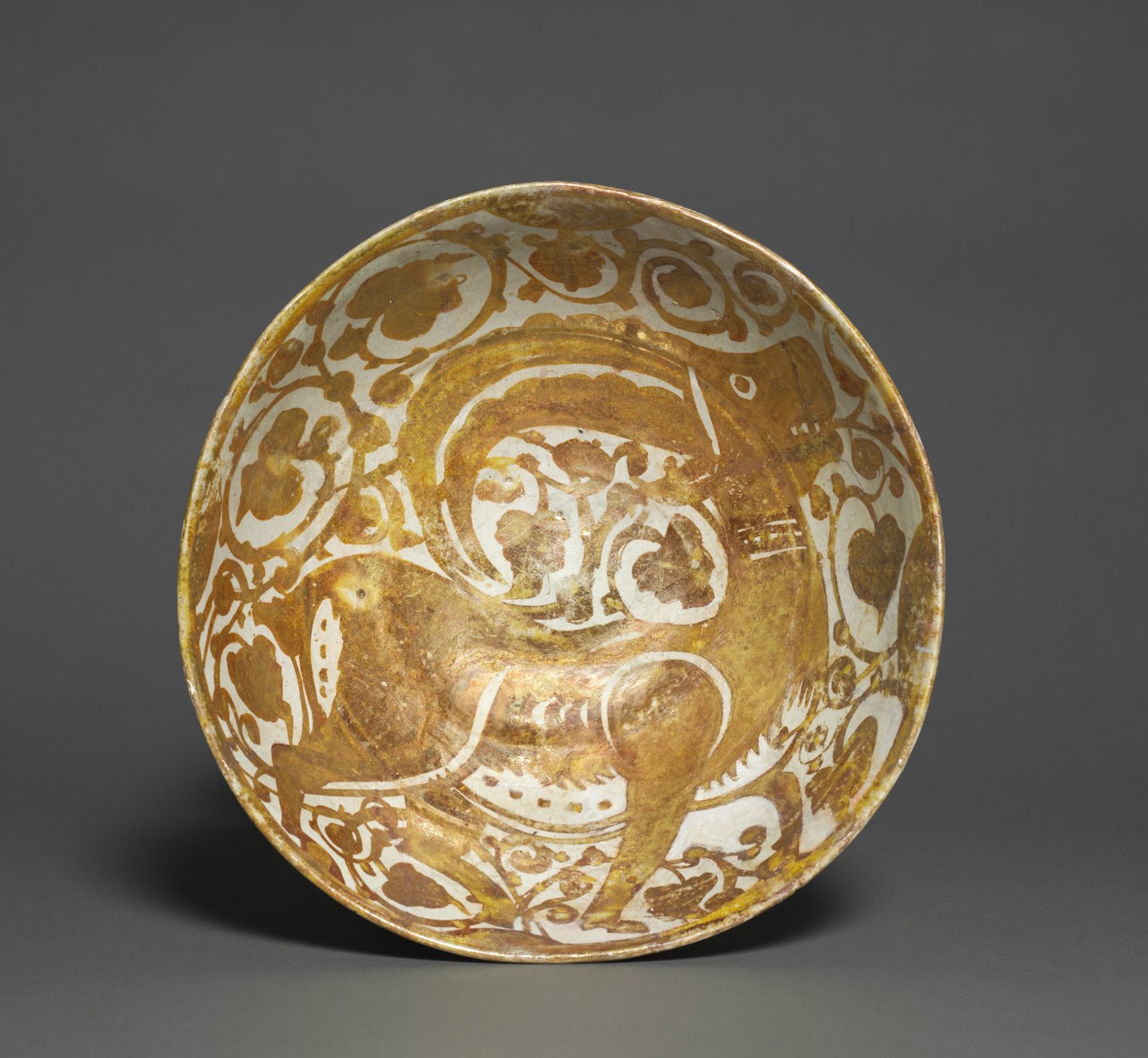
Cleveland’s Luster Bowl with Ibex, dated to the 1000s and associated with Fustat in Egypt, is described as earthenware with luster-painted design. The museum identifies the technique as demanding and historically associated with skilled production. Its record provides dimensions, a collection number, and an image available through open access. Object record
In the museum photograph, the ibex’s long curved horn and the surrounding leaves share the bowl’s interior. Wear interrupts the gold-colored design in places. That visible condition belongs to this historical object; it is not a quality standard for a new purchase.
Use that example to practice asking precise questions. What is the clay body? How was the color applied? Is the surface effect part of the glaze, a painted layer, or another process? A contemporary maker can explain the method used for the actual piece in front of you.
A related Cleveland record, Luster Bowl with Antelope, offers another object for comparison. Look at the animal’s placement and how the surrounding forms occupy the curved surface. The comparison can sharpen your eye without turning a historical label into a claim about a new product. Comparison record
At a market, a seller may make the object, decorate an existing form, collaborate with another studio, or retail another maker’s work. Ask which description applies. Each can involve worthwhile craft, but the product description should accurately identify it.
If a piece is described as handmade, ask what that means in its production. The shape may be thrown, molded, slab-built, or assembled by another process. A printed design and a hand-painted design create different kinds of surface. Look for a clear account rather than relying on the word artisan.
For a commission, establish whether you are choosing from an existing design or asking for a new one. Confirm the size, number of pieces, color expectations, approval process, and delivery date in writing.
The Islamic Arts Society’s account of its founders includes ceramic tile artist Khawaja Azimuddin among the people involved in its Houston work. Its festival archive documents art displays and sales by participating artists. These are useful routes toward living practitioners and events, with current availability checked directly. Society background · Archived sales program
Treat a previous festival listing as a lead. Ask whether the artist currently has work for sale, accepts commissions, or attends an upcoming event. Save the artist’s own website or preferred contact route so a later purchase reaches the intended maker.
The historical and contemporary context may be part of the conversation. Ask the artist which traditions, teachers, or materials they cite. Attribute that explanation to the individual rather than applying it to every piece with a similar pattern.
For a display piece, ask about cleaning and handling. Can the surface be touched or wiped, and does the maker recommend a particular support? Obtain instructions for this object rather than treating every glazed ceramic alike.
For wall work, ask what mounting method the maker recommends and whether hardware is supplied. Record the weight and dimensions before choosing the location. A shelf piece may also need a stand, and the stand should be included in your total budget.
If shopping online, request an overall photograph, a side view, a base view, and a close view of the surface. Include an object of known size or exact measurements. Photographs taken in strong directional light can change the apparent intensity of a reflective surface.
Retain the maker’s name, title if provided, date, material description, receipt, and care instructions. Photograph the piece when it arrives and follow the seller’s procedure if there is shipping damage.
A modest purchase can still deserve a good record. Years later, a signature may be difficult to read and a seller’s account may have changed. The information you keep now preserves the connection between the object and the person who made it.
For more practice reading the material and accession lines, explore Cleveland’s Islamic collection. If you want an image of a historical object rather than a new ceramic, the museum-image print guide explains that different route.
ShopPrepare a clear brief for a calligrapher, from verified wording and script preferences to framing and delivery.
ShopFind a documented museum image, check its reuse status, and prepare a print that preserves the artwork’s identity.
 Shop
Use the Tatreez Institute’s publications and teaching resources to choose an entry point into Palestinian embroidery.