

 Community
Public service and national service
Five ways to explore Muslim American service, from a military chapel and a veterans’ hospital to Congress and diplomacy.
What a historic Senate confirmation tells us about representation, diplomacy, and responsibility across faiths.
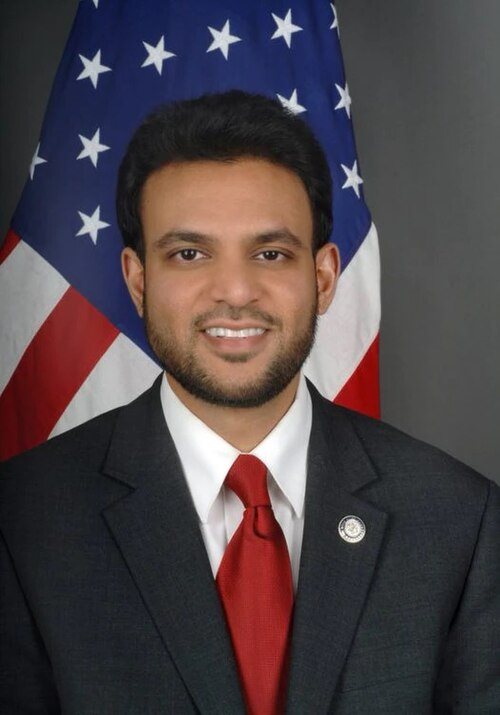
On December 16, 2021, the United States Senate confirmed Rashad Hussain as ambassador-at-large for international religious freedom. The official roll call records 85 votes in favor, five against, and ten senators not voting. That short document fixes a moment in American public life more precisely than a description such as widely supported ever could.
Religion News Service identified Hussain as the first Muslim American confirmed to the role. The significance lies partly in who could now hold the position. It also lies in the nature of the responsibility: a Muslim public servant was entrusted with a portfolio concerning the rights of people across religious differences.
The Senate's official record identifies the nomination and individual votes. The appointment followed a career already connected to international relationships and public policy.
Reporting at the time of confirmation placed Hussain's appointment within a longer government career. Religion News Service described prior work in the Obama White House, as special envoy to the Organization of Islamic Cooperation, and at the National Security Council. It also reported his public identification as a Muslim American during the confirmation process. Read the contemporary reporting.
That career context changes the story. The appointment was not simply a ceremonial recognition of identity. It followed experience with institutions, policy, and international relationships. Representation and professional preparation can be discussed together without pretending that religious identity alone explains a person's work.
A useful profile therefore asks two questions. What barrier or precedent did the appointment change? What preparation did the person bring to the responsibilities? Answering only the first risks turning a working public servant into a symbol with no actual job.
The reporting also described support for Hussain from people and organizations with different religious and political perspectives. It noted his work addressing antisemitism and the treatment of minorities in Muslim-majority countries. This is relevant because religious-freedom work cannot be evaluated solely by benefits to the official's own community.
The practical principle is reciprocity. If freedom matters, it matters when the person seeking it believes differently from the official advocating for it. That principle gives the milestone its public-service meaning. It is possible to recognize the significance of a Muslim appointment while keeping the interests of the people served at the center of the article.
Support at confirmation is evidence of expectations and confidence, not proof of every later outcome. A statement welcoming a nominee expresses a judgment by its author. It should remain attributed to that author rather than becoming an editorial guarantee.
In February 2022, Hussain delivered recorded remarks to a U.S. Commission on International Religious Freedom hearing about anti-Muslim policies and bias in Europe. He connected the issue with antisemitism, xenophobia, and the treatment of other minorities. He also described his office's work documenting discrimination in annual reports and engaging with governments. Read the hearing remarks.
The speech makes the scope of the job concrete. It involved gathering and presenting information as well as building relationships capable of responding to it. The official's own religious identity did not restrict the range of people whose rights concerned the office.
Later that year, journalist Kelsey Dallas interviewed Hussain during his visit to Utah for Brigham Young University's International Law and Religion Symposium. In the interview, he traced his interest in minority rights to conversations with Christians who had supported American Muslims and raised concerns about Christians abroad. He linked that work to the 2016 Marrakesh Declaration. Read the interview.
He also recalled visiting Rohingya refugees in Cox's Bazar and working to build support for them. Those are his accounts of the work, rather than independently measured outcomes. They nevertheless reveal the relationships and places behind a title that can otherwise sound abstract.
For students considering public service, Hussain's path shows how legal work, policy experience, and relationships across religious communities can connect. The role called for explaining American priorities abroad while listening to people affected by persecution and discrimination.
For readers interested in Muslim American life, it shows a form of participation that reaches beyond domestic community affairs. A person can carry a publicly acknowledged religious identity into a role defined by obligations to a much wider public.
Read André Carson's congressional profile for a different relationship between representation and daily institutional work. The public service collection also follows chaplains and emergency service, keeping the focus on the responsibilities attached to each role.
CommunityFive ways to explore Muslim American service, from a military chapel and a veterans’ hospital to Congress and diplomacy.