
 Community
Public service and national service
Five ways to explore Muslim American service, from a military chapel and a veterans’ hospital to Congress and diplomacy.
How Muslim chaplains made a place within military religious support and served people across faiths.
Abdul-Rasheed Muhammad brought two kinds of experience to Army chaplaincy. He had served as an enlisted soldier and worked as a civilian corrections chaplain. When the Army accepted its first Muslim chaplain in the early 1990s, it gained someone familiar with both military life and the demands of serving people inside an institution.
His appointment is usually remembered as a milestone in representation. The work behind it also shows how religious support becomes a practical service. A chaplain needs recognized credentials, an endorsing organization, relationships with colleagues, and the ability to respond when someone else's needs differ from their own.
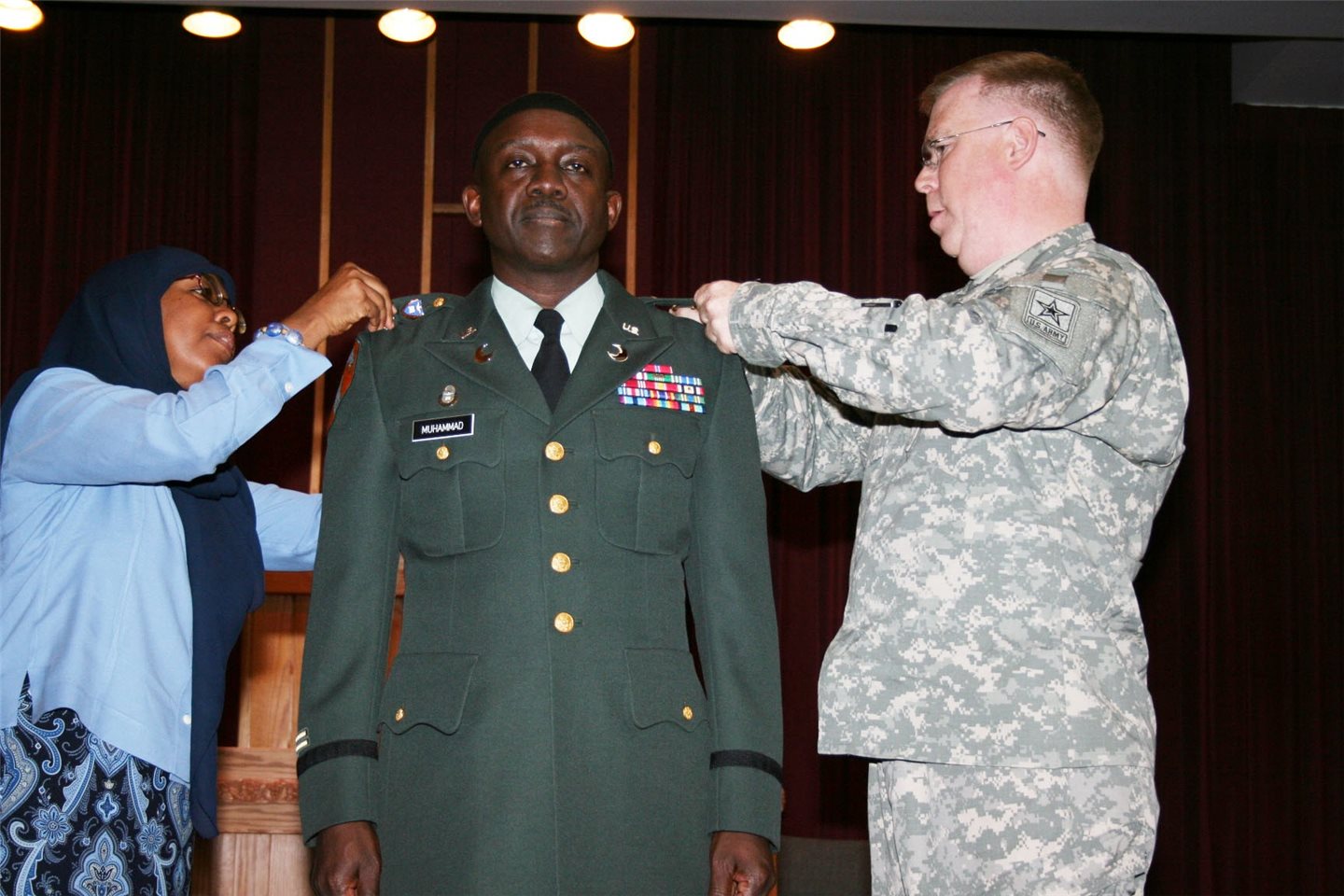
In its 2009 account of Muhammad's promotion to lieutenant colonel, the Army reports that he had been an imam since 1978, served as an enlisted soldier from 1982 to 1985, and worked as a chaplain for New York State's corrections department. The same account identifies the Islamic Society of North America as the endorsing organization through which he applied for military chaplaincy. Read the Army's account.
The endorsement detail matters. His entry required a connection between an American Muslim institution and the military's existing process for recognizing religious representatives. The achievement involved building a route that other applicants could follow.
Muhammad described his ambition in terms of doing the job. At the promotion ceremony, colleagues from different faith traditions participated in recognizing his service. That setting places the milestone inside a professional community whose members must work together even when they worship differently.
Army publications do not all give the same year for the first Muslim chaplain. The 2009 profile says 1994. A 2023 Chaplain Corps history gives 1993. Without a personnel record resolving the distinction, it would be misleading to silently choose one and present it as certain.
The dates may reflect different administrative stages, but the sources reviewed here do not establish that explanation. The supported description is that Muhammad became the armed forces' first Muslim chaplain in the early 1990s. Readers building a precise timeline should retain the discrepancy in their research notes. Compare the Army's 2023 history.
This care does not diminish the appointment. It lets a reader distinguish the documented institutional change from an unresolved detail in the chronology.
The Army's 2018 profile of Muslim chaplain Ibraheem Raheem provides a later example of what the role involves. Raheem trained fellow chaplains in Clinical Pastoral Education at Army medical centers. His assignments included supporting patients and families through serious illness and bereavement.
The profile describes a Christian soldier with terminal cancer who wanted to marry his fiancée. Raheem coordinated with medical staff and a Christian chaplain to help arrange the wedding. The contribution was shared across a care team, and the patient's wishes guided the response. Read the profile of Ibraheem Raheem.
That account shows why a Muslim chaplain's contribution cannot be measured only by counting Muslim service members. Religious familiarity can help someone feel understood. Professional responsibility also requires making space for a different belief and bringing in the appropriate colleague.
Military religious support includes ordinary coordination as well as extraordinary moments. The Raheem profile describes the scheduling challenge of Friday congregational prayer during a duty day. A chaplain can explain the request, work with a command, and help an institution understand the needs of the people serving in it.
Those tasks are easy to overlook beside a headline about a first appointment. Yet they are how a policy or principle becomes usable in everyday life. A request has to reach the right person. Someone needs to understand the context. The response has to fit the assignment and the individual.
Muhammad's earlier military experience and later chaplaincy are therefore connected parts of the story. They show a professional learning the organization from more than one position, then using that knowledge to serve within it.
For a broader view, read this account alongside the history of campus and national Muslim institutions. ISNA's place in the endorsement process illustrates one way a community organization can participate in public institutions.
The next chapter also extends beyond active duty. Omer Yigiter's work with veterans follows spiritual care into civilian life. Together, the two stories describe service as a continuing relationship with people whose needs change over time.
CommunityFive ways to explore Muslim American service, from a military chapel and a veterans’ hospital to Congress and diplomacy.