
 History
Muslims who helped shape American science and technology
Five stories connect laboratories, skyscrapers, space exploration, and computing through the work of Muslim American scientists and engineers.
Read Chicago’s towers through their structural systems, with credit to Khan, Bruce Graham, and the teams who built them.
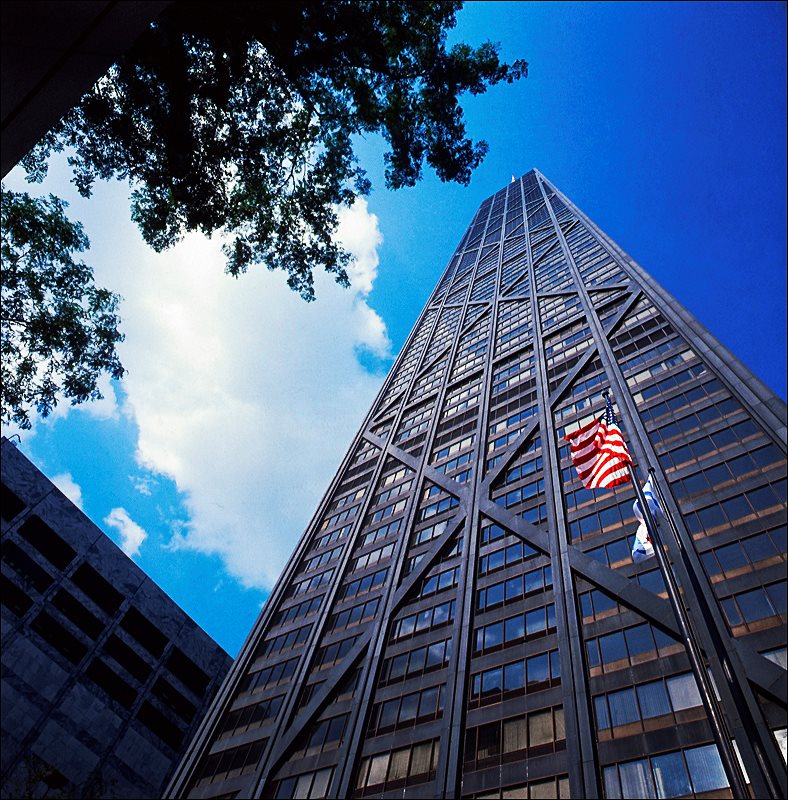
The huge diagonal braces on Chicago's former John Hancock Center are part of the building's engineering. They help make its height possible. For someone looking up from the street, they also provide an unusually visible introduction to the work of Fazlur Rahman Khan, the structural engineer whose collaborations at Skidmore, Owings & Merrill changed tall-building design.
His contribution is easiest to understand through a practical question: how can a very tall building resist sideways forces while leaving useful space inside? Height alone is not the whole problem. A tower must carry its weight, respond to wind, accommodate occupants, and use materials in an arrangement that can actually be constructed.
SOM's account of its structural history traces Khan's work on tubular systems through the 42-story DeWitt-Chestnut apartment building. Closely spaced concrete columns around the perimeter worked together as a relatively thin structural tube rising from the ground.
The word tube can be misleading if it brings to mind a round pipe. The relevant idea is collective behavior around the perimeter, not necessarily a circular shape. Instead of imagining every column in isolation, imagine a connected exterior system responding to loads as a whole.
At the Hancock tower, Khan and architect Bruce Graham developed the braced-tube approach. The diagonal members made the structural idea legible on the facade. SOM's retrospective identifies both men, an important correction to accounts that credit either architecture or engineering alone.
A memorable building can be the work of a memorable partnership. It still also depends on draftspeople, fabricators, contractors, construction workers, wind specialists, and many other participants. Recognizing Khan's role does not require making those contributions disappear.
Sears Tower, now Willis Tower, uses another arrangement: a bundle of nine square tubes at its base. SOM describes each base module as 75 feet by 75 feet. The tubes end at different heights, producing the tower's stepped outline.
That form answered a client's program as well as a structural problem. Sears wanted large floors for its operations and smaller floors that could accommodate other tenants. The bundle allowed the building to change its floor area as it rose.
This is a good example of how a skyline can preserve a business decision. The profile is not an arbitrary sculpture attached to an office building. It records an interaction between usable floor space, engineering, and architectural composition.
When comparing dates, be careful: SOM's project page gives a 1974 completion year in its facts panel while describing completion in 1973 in the narrative. That discrepancy does not affect the structural account, but it is a reason to avoid using one unqualified completion date from this page. A responsible architectural history can acknowledge imperfect documentation.
Lehigh University's 2009 account explicitly identifies Khan as Muslim and discusses President Obama's reference to him in a Cairo speech. The same university account records his United States citizenship in 1967 and his partnership at SOM in 1966. His inclusion here rests on published identification, rather than an assumption about a Bangladeshi name.
Lehigh also documents a continuing educational legacy: an honorary doctorate awarded to Khan in 1980, an endowed structural-engineering chair, and a lecture series. These are a different kind of contribution from a tower. They connect his name to teaching and professional discussion after his death in 1982.
The speech is useful as evidence of public recognition, but the buildings remain the stronger evidence of engineering accomplishment. A political tribute cannot explain how a structural system works. For that, the project records and engineering histories matter more.
A Chicago architecture walk can become more rewarding with a simple comparison. Look at the Hancock tower's diagonal braces, then at the changing heights of the Willis Tower modules. Ask what each exterior reveals about its structural organization.
A photograph from far away may show the entire silhouette but conceal connections and details. A closer street view can reveal the braces while making the building's overall proportions harder to judge. Both views are useful; neither should substitute for a structural explanation.
It also helps to distinguish a building's original engineering from later changes to its observation areas, entrances, or commercial spaces. A contemporary visitor experience is not necessarily part of Khan's design. This distinction prevents a profile from accidentally crediting him with work completed decades later.
Khan's story shifts attention from celebrity height records to the quality of an underlying solution. An efficient structural arrangement can influence many projects even when people do not know its inventor's name. In that sense, engineering can shape a city while remaining partly invisible to those who use it.
There is no need to suggest that one person invented skyscrapers or that every modern tower descends from a single idea. The documented achievement is substantial enough: Khan helped develop structural systems that widened the possibilities of tall-building design through American practice.
Continue with Farouk El-Baz and Apollo geology for another story of technical work behind a highly visible national achievement. Both accounts reward looking beyond the familiar exterior image to the expertise that made it possible.
HistoryFive stories connect laboratories, skyscrapers, space exploration, and computing through the work of Muslim American scientists and engineers.