
 Art
How the Freer Gallery Helped Shape Islamic Art Scholarship in America
Charles Lang Freer, the museum's 1923 opening, and the journals that helped establish Islamic art scholarship in the United States.
Explore manuscript painting, a Samanid bowl, and object histories at Washington's National Museum of Asian Art, with practical planning links.
A Persian manuscript scene and a broad Samanid bowl offer two starting points at Washington’s National Museum of Asian Art. One arranges writing around a painted story; the other carries an inscription around a curved surface. Begin with those differences, then follow the objects’ histories through the museum’s records.
The museum identifies illustrated manuscripts and ceramics as particular strengths among more than 2,200 objects associated with the arts of the Islamic world. Its definition covers many regional traditions across a large geographic area. Begin with that range in mind and look for the place and period attached to each work. Collection introduction
The museum's record for a folio from Nizami's Khamsa describes Khusraw and Shirin feasting at night in a desert encampment. The catalog distinguishes the illustrated side from the text side and identifies Persian writing in nasta‘liq script. It also connects the leaf with a larger manuscript.
Those details suggest a practical way to look. First follow the scene as a composition. Then locate the text. Finally, ask what changes when the page is viewed alone rather than within the sequence of a book. The catalog allows a reader to move from an appealing image toward the object's original format. Folio record
You do not have to translate every line to notice how the page was organized. Compare the space allotted to writing and painting. Look for changes at the margins. Ask whether your eye moves across the illustration in the same direction as the written lines. Keep those observations distinct from a claim about what the artist intended unless a source supports that interpretation.
For a concrete second stop, look for the tenth-century Iranian bowl numbered F1957.24. The museum records it as earthenware painted beneath transparent glaze, nearly forty centimeters across, and locates it in West Building Gallery 3 when checked. Five branches with palmette ends turn around a central rosette. An Arabic inscription sits within a surrounding band of red and black decoration. The museum interprets its text as advice against relying solely on one's own opinion, followed by a blessing for the owner. Bowl record
Compare how writing occupies this curved surface with its placement on the manuscript page. The bowl's turning stems and encircling inscription make your eye move differently. Its scale also matters: the online photograph can conceal how broad the vessel actually is. Confirm display status before traveling.
The museum's virtual tours offer another way to approach manuscripts, metalwork, and ceramics before a visit. Check the current booking format directly. Virtual tours
The Smithsonian's “Manuscripts on the Move” project draws attention to inscriptions, repairs, and notes as evidence of a manuscript's travels. Its examples concern works that eventually entered Istanbul's Museum of Turkish and Islamic Arts. This is a useful companion to an American museum visit because it shifts attention from the moment of manufacture to later ownership, use, and preservation. Digital project
When a label offers a provenance or acquisition history, read it alongside the artistic description. Record an uncertainty as an uncertainty. A gap in the published chain of ownership is a reason to seek more information, rather than a basis for inventing a story.
The temporary exhibition From the Louvre: Masterpieces of Islamic Art is scheduled for September 26, 2026 through January 18, 2027, in East Building Galleries 23 and 24. Exhibition dates
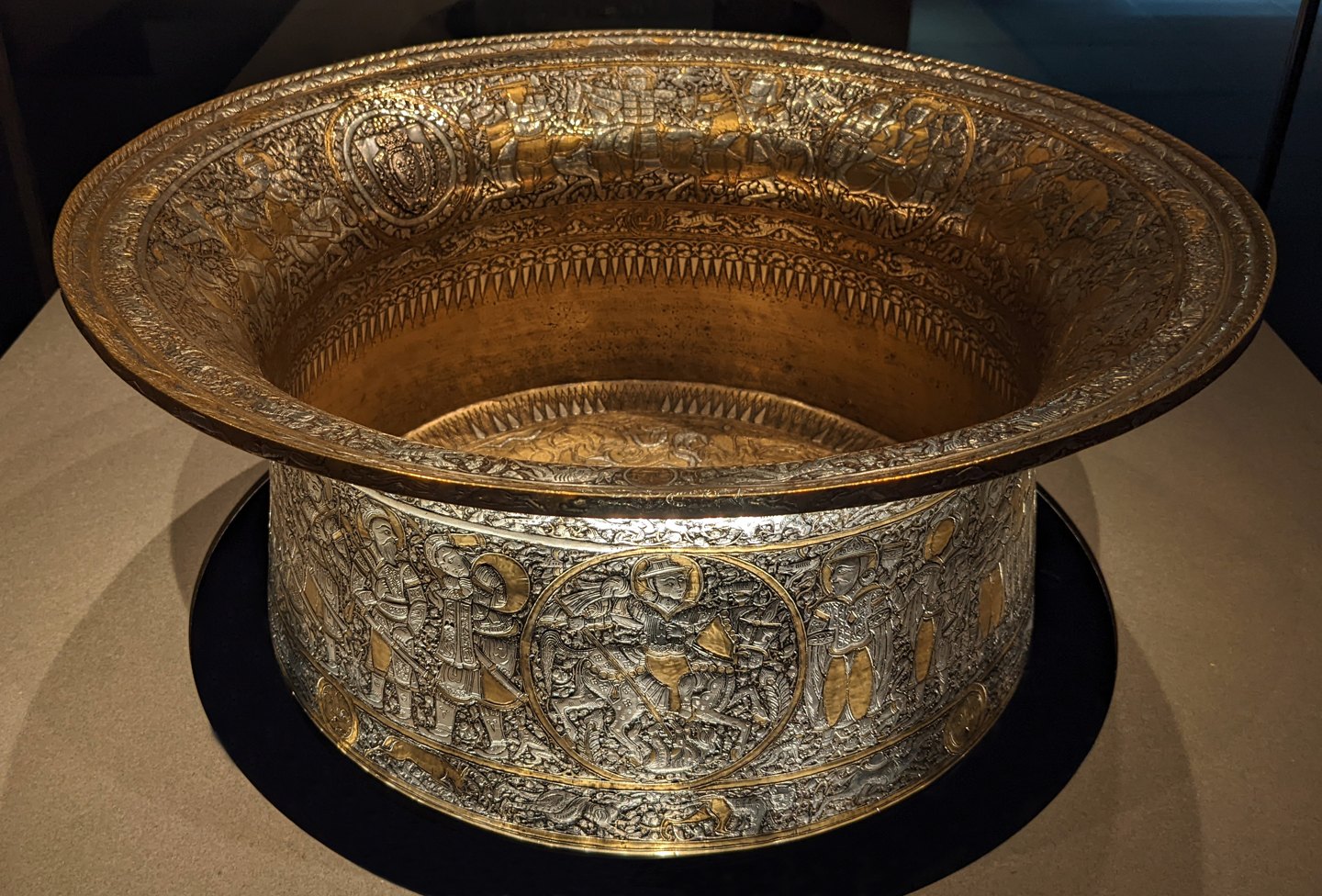
The Smithsonian's account of this collaboration introduces an especially revealing example: the fourteenth-century basin commonly called the Baptistery of Saint Louis. The museum describes a vessel made in Syria or Egypt, with gold and silver inlay, originally intended for a secular purpose such as ceremonial hand washing. In France it acquired a different role, including use in the baptism of Louis XIII in 1606. Its later name and use should therefore not be confused with its original setting.
Another highlighted object, an eighteenth-century portrait of Fath-Ali Shah Qajar, moved from a Persian royal residence into diplomatic exchange as a gift to Napoleon. These examples show how ownership and use become part of an artwork's history. A useful comparison is between what the maker created, what an early patron wanted, and what subsequent owners made the object signify. Consult the current exhibition dates separately: a loan exhibition is not the same thing as a permanent Smithsonian holding. Source
The photograph above makes the inner and outer bands visible together. Compare their figures and the narrow ornamental borders between them before turning back to the museum's account of the basin's later use. The image documents the object at the Louvre in 2022, not its placement in the current Washington exhibition.
Before leaving home, choose a question about material, another about storytelling, and a third about an object's journey. Bring them to a small number of works. This creates a coherent visit even when the display differs from the objects you first encountered online.
The museum is at 1050 Independence Avenue SW in Washington, DC. Its visitor page lists free admission with no entry ticket required, checked November 13, 2026. Follow the page's directions and accessibility links to plan your arrival, then confirm exhibition and object display status. Visitor information An archived exhibition remains valuable research but is not evidence that its objects are available today. For a group, share collection links beforehand so everyone can select one work or question.
Afterward, save the object titles and accession numbers with your own notes. The result is a personal reading list grounded in specific artworks. It can grow across future visits without requiring every object to fit a single account of Muslim life or artistic production.
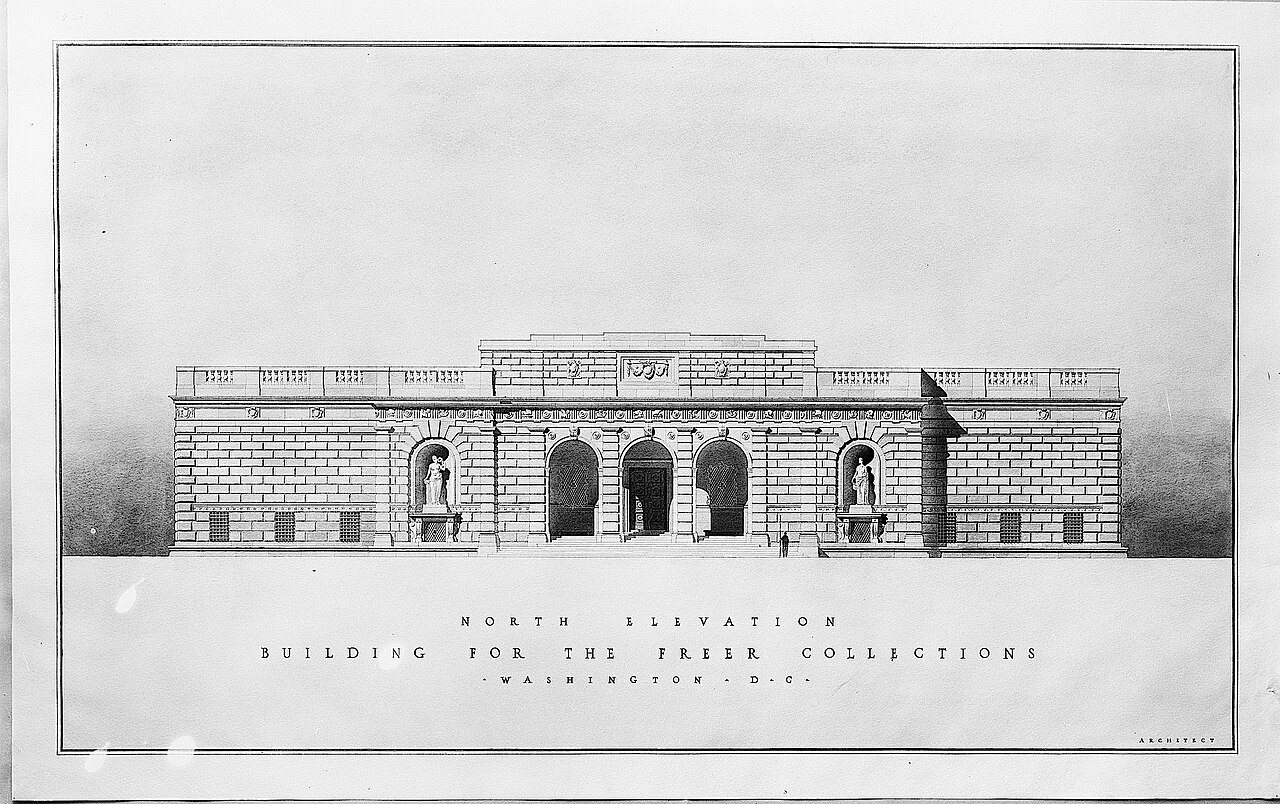
ArtCharles Lang Freer, the museum's 1923 opening, and the journals that helped establish Islamic art scholarship in the United States.