
 Art
How to Explore Islamic Art in Cleveland’s Open Collection
A close-looking guide to a Qur’an folio and luster ceramics, using Cleveland’s public collection records.
Learn to follow repetition, symmetry, borders, and materials without reducing every pattern to a single meaning.
A geometric pattern can look impossibly complicated until you choose a single unit to follow. A star, polygon, or crossing line may repeat across a surface, rotate into another position, or disappear at an edge. Museum collections offer a way to study those decisions through actual objects and the records attached to them.
The Met’s educational introduction traces geometric ornament through earlier artistic traditions and its continued development across Islamic societies. It describes the role of repeated units, circles, lines, and polygons. That history encourages close attention to how a pattern was made and adapted, rather than treating geometry as a timeless symbol with one universal meaning. Met introduction
Choose a small section you can recognize again. Trace it visually to the left or right. Does it return in the same orientation, or has it turned? Does the next unit share an edge, a point, or a line?
Then step back. The shape you first noticed may be only one part of a larger arrangement. A star can appear to be the central motif until the spaces between stars form another pattern. This shift between figure and surrounding space is one reason a surface can hold attention for a long time.
The Met’s resource on primary characteristics discusses repetition, mirroring, and the extension of patterns. Use its vocabulary when it helps describe what you see. Keep a distinction between an observable symmetry and an interpretation about the pattern’s spiritual meaning. Pattern characteristics
Borders are often more revealing than the middle of a pattern. Look at how the design meets a rim, arch, corner, or frame. Does a unit stop abruptly? Is there a smaller band that separates it from the edge? Does the maker change the scale to fit the available space?
These questions reveal the design as a solution for a particular object. A pattern on a bowl must negotiate a curved surface. A pattern in an architectural opening has to work with its frame and the view through it. The material and format shape what the design can do.
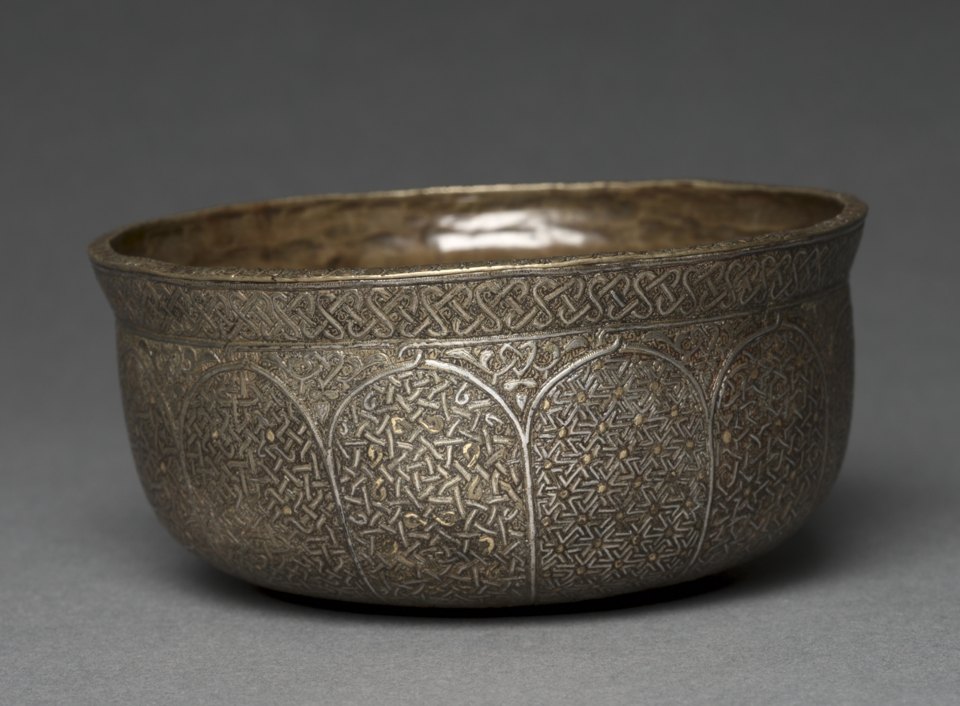
Cleveland’s Bowl with Geometric Designs provides one specific collection record to investigate. Read the object’s material, dimensions, and date before comparing it with a tile or screen elsewhere. Its catalog title alone should not substitute for the full record. Cleveland object
Cleveland's example is a brass bowl from Damascus, dated 1450–1500, with silver and gold inlay. It measures only 13.2 centimeters across, yet its exterior contains twelve arched panels. Six different geometric designs appear twice, with matching patterns set opposite each other. A star anchors the underside, while six fish form a rotating arrangement inside. This is a particularly clear case in which geometry and animal imagery coexist on one object.
Use the digital views to compare opposite panels and then locate the change between the exterior's compartmentalized designs and the interior's circular movement. The museum's record lists it as not on view, so this exercise can be completed from home rather than built around a promised gallery encounter. The record explicitly permits image reuse. Source
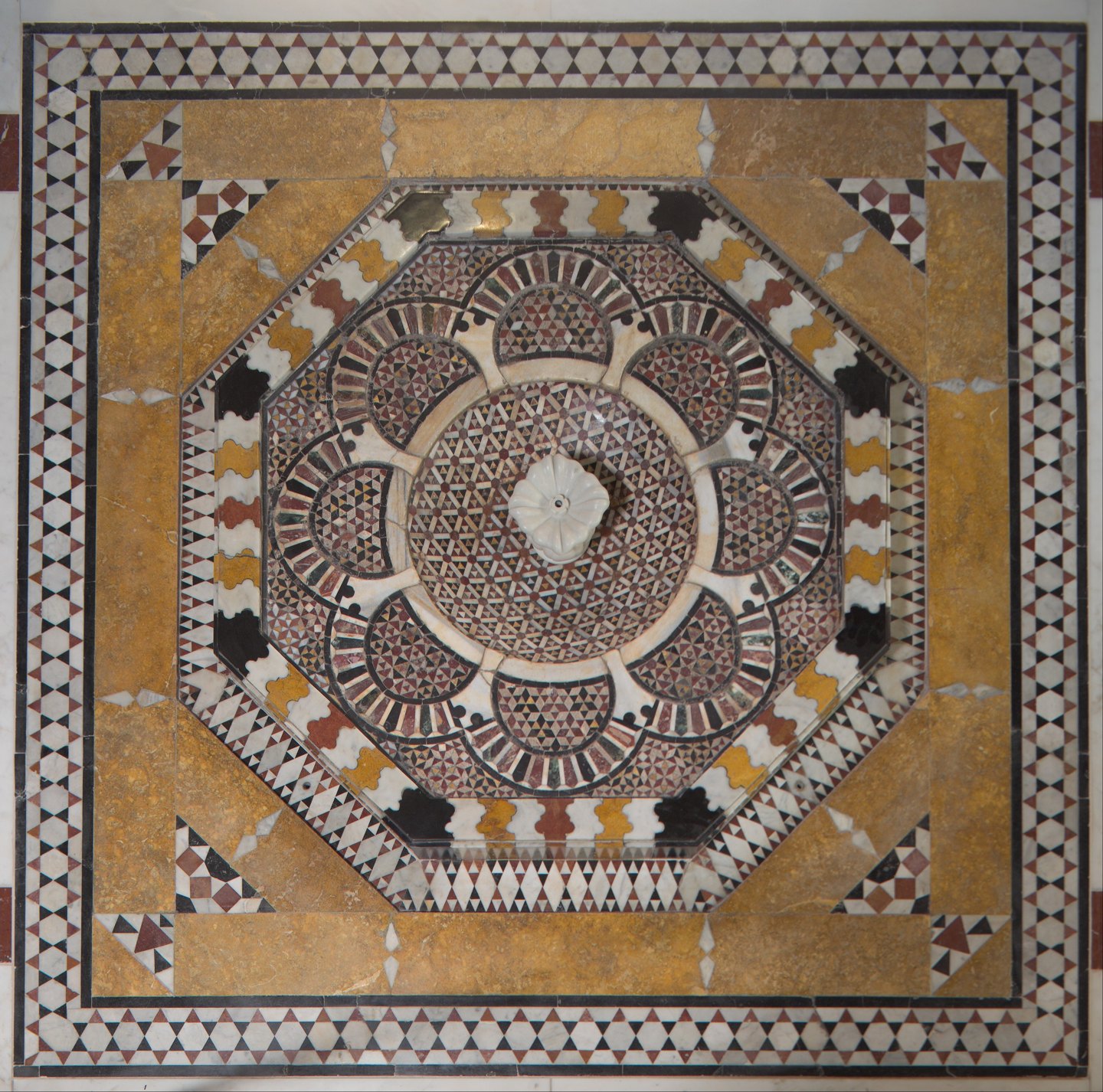
The overhead photograph of the Met’s Damascus Room fountain offers a second surface to study. Follow the small repeating units around the outside border, then the angled frame inside it, then the curved outline of the fountain. Unlike the bowl’s arched compartments, these bands organize a floor around a central feature. Compare where repetition continues and where a corner requires a change. Damascus Room record
For a practical exercise, choose a repeat that fits within a hand-sized area. Draw only its main lines, then add a neighboring unit. A ruler and pencil can make the relationship easier to see. If drawing in a gallery, follow the museum’s material and space rules.
The Met publishes a dedicated geometric-design activity resource with grids and exercises. It can support a home or classroom session after a visit. Use the resource’s instructions rather than presenting your own quick sketch as a historically exact reconstruction of a maker’s method. Activity resource
A mistake in a sketch can be informative. If the second unit fails to connect, examine the original again. You may have chosen the wrong repeat or missed a change in angle. That process makes the design’s organization tangible.
Save the museum name and accession number with any study. Write down the place and period supplied by the record and preserve qualifications such as “attributed to” or “probably.” A compelling pattern should not erase the history of the object that carries it.
Also notice what accompanies the geometry. Writing, plant forms, colors, or figures may interact with the repeated shapes. Describing those relationships gives a fuller account than labeling the whole surface geometric.
For children, a manageable challenge is to find two shapes that share a side and one pattern that continues beyond the visible area. For adults, compare how the same basic shape changes across two materials. Both exercises can lead to a specific question for a docent or catalog.
The reward is a more precise way of seeing. A surface that first appeared densely decorated becomes a sequence of choices about repeat, scale, interruption, and edge. Those choices belong to makers working with particular tools and objects, and the museum record provides the route toward understanding them.
ArtA close-looking guide to a Qur’an folio and luster ceramics, using Cleveland’s public collection records.
 Art
Explore rock crystal, metalwork, manuscripts, and textiles through the Dallas Museum of Art’s Keir Collection records.
 Art
Hassan Fathy’s New Mexico mosque connects Muslim community-building, earthen construction, and a changing vision for life in the American Southwest.